20.05.2009
Physicists want to redefine units of measurement. Also the "Muggaseggel"?
Anyone who is not satisfied with rough estimates in both private and professional life needs globally valid and consistent units of measurement. In short, standards. Since 1875, responsibility for measurement and weighing has rested with the International Bureau of Weights and Measures in Sèvres near Paris.
Among other things, this is where the so called reference artifacts are kept, including the international prototype of the kilogram, a cylinder made of platinum iridium, and the international prototype of the metre, a bar made of the same material. The International Bureau of Weights and Measures is responsible for the base units of length, mass, time, electric current, thermodynamic temperature, amount of substance and luminous intensity.
With regard to the kilogram prototype, scientists are currently debating whether it may have lost mass over the years. There is no such debate about the definition of the metre. It is defined as the distance travelled by light in a vacuum during 1/299,792,458 of a second.
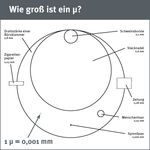
There is also no doubt that at Haas Schleifmaschinen we grind with our Multigrind® machines to micrometre accuracy, that is 0.000001 metres or 10⁻⁶ metres. And we do so without compromise.
Whether and when scientists will ever concern themselves with the original Swabian unit of measurement known as the Muggaseggele remains to be seen. Do you know what a Muggaseggele is and how much it measures? Write to us.
The author
Thomas Bader
Managing Director
Thomas Bader is an enthusiastic aerobatic pilot, engineer with heart and soul and managing director at Adelbert Haas.
Share article

Comments (0)
Write a comment