01.02.2010
Crisis as an opportunity or how to break knee implants over the knee
To be honest, can you still listen to all this talk about the crisis as an opportunity? These prefabricated PowerPoint phrases claiming that companies have done their homework on product innovation during the crisis and are now ready to overrun the market with groundbreaking new developments. We have been hearing this for months, from the local snack bar to global players alike.
Decisive is' on'm place or time for a mid-term review
As people from Germany’s Ruhr region, we are not particularly fond of empty talk. “Theory is grey, what matters is what happens on the pitch,” as Adi Preißler once said. He remains Borussia Dortmund’s all‑time top scorer with 168 goals.
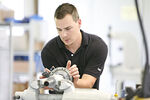
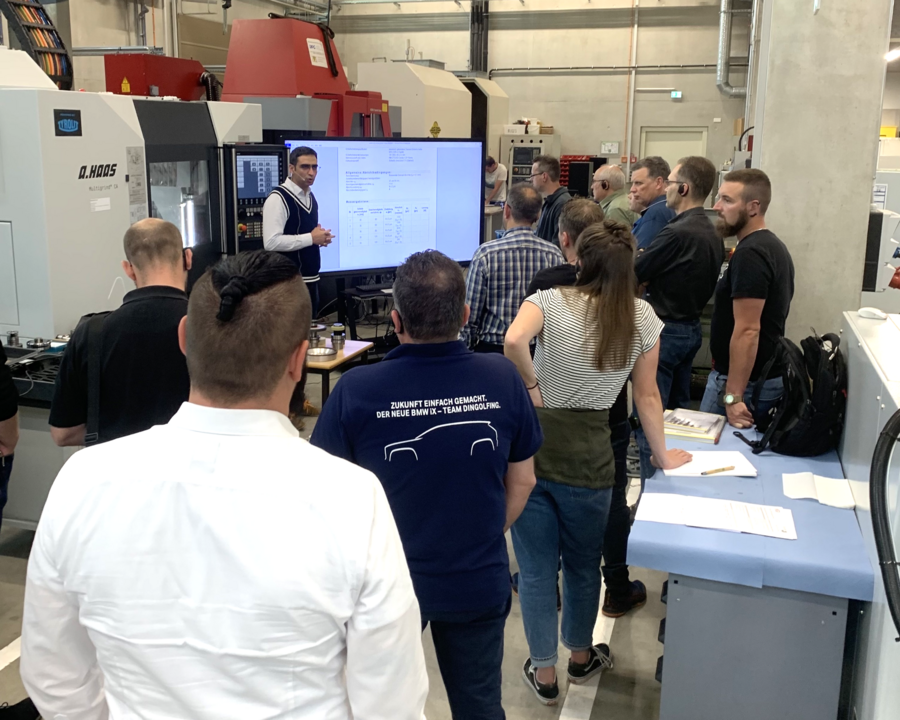
Haas Schleifmaschinen: A look into the production.
As grinding machine manufacturers and fair competitors, we naturally welcome it when rivals we respect push technological development forward. Everyone benefits from that, provided something genuinely new emerges.
What we do find amusing, however, is when certain grinding or milling machine manufacturers suddenly act as if they had invented or perfected the production of knee joint implants. To put it bluntly, that is nonsense. To me, it sounds like someone who has just mastered frying an egg trying to teach chef Vincent Klink how to cook.
One million knee endoprostheses per year or experience makes quality
“Every tool must be shaped through experience,” Leonardo da Vinci is said to have remarked. At Haas Schleifmaschinen in Trossingen, we have around ten years of experience in grinding artificial knee joints. Worldwide, more than one million knee endoprostheses are produced each year on Multigrind® CB machines. That is a significant number, and there is a reason for it.
We were not involved from the very beginning. The first modern joint surface implants were developed in the early 1970s. But our engineers know exactly what they are talking about. They are also fully aware of the responsibility borne by our customers who manufacture knee and hip implants. The knee joint is not only the largest joint in the human body, it is also one of the most complex.
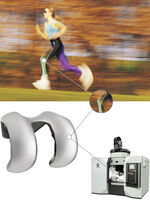
Haas Schleifmaschinen: Knee implant, manufactured on a Multigrind® CB.
It is therefore no surprise that implanting an artificial knee joint is among the most demanding surgical procedures and that manufacturing these implants represents a supreme discipline for grinding machine manufacturers. Whether a patient can return to an active, pain‑free life after surgery depends to a large extent on the quality of the implant. Compromises or a lack of experience in production can be painful and costly. Who would want to take that risk?
Continuous dressing or technical jumps instead of big slogans
What a genuine technological leap in knee implant manufacturing looks like will soon be demonstrated live at the GrindTec trade fair in Augsburg and, of course, at any time at our facility in Trossingen.
One such advance is continuous dressing. This process allows grinding wheels on a multi‑axis Multigrind® CB machine to be dressed during the grinding operation for the first time. It ensures maximum dimensional accuracy and outstanding surface quality. That is what I call real innovation.
As I said, what matters is performance on the field. Or what do you think?
The author
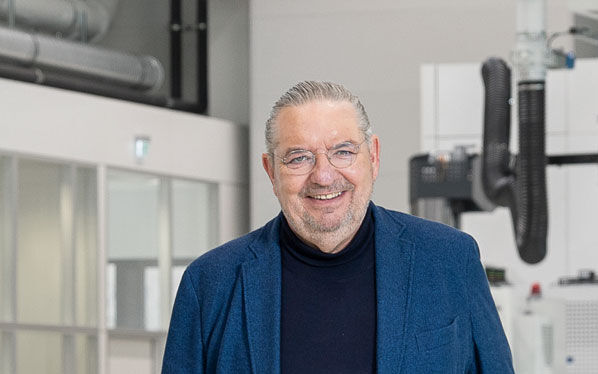
Dirk Wember
Managing Director
Dirk Wember is an enthusiastic pilot, passionate engineer and managing director of Adelbert Haas.
Share article
Comments (0)
Write a comment