17.02.2011
Precision and infinity
You may remember this topic. Two years ago, we discussed the international prototype of the kilogram and its planned redefinition here on the grinding blog. This step has become necessary because the original kilogram, a cylinder made of platinum and iridium measuring 39 millimetres in height and diameter, has been losing mass over time. It is becoming lighter. The exact reason remains unknown. Scientists at Germany’s National Metrology Institute, the Physikalisch‑Technische Bundesanstalt in Braunschweig, are now working on redefining the kilogram.
Counting atoms is not for the faint‑hearted
To achieve this, researchers at the PTB are using a highly pure silicon sphere with a diameter of just under ten centimetres. This sphere is used to determine the so‑called Avogadro constant with the highest possible accuracy. The goal is to count the atoms contained in a one‑kilogram silicon sphere. A truly Herculean task on a macroscopic scale, one that would challenge even the most meticulous bean counter.
The result will be an enormous 24‑digit number known as the Avogadro number, which defines the number of particles per amount of substance. The researchers are extremely exacting, allowing an uncertainty of only two millionths of a percent. Only then will the kilogram be redefined based on the number of atoms of a specific type. The original kilogram would thus retire as a reference.
From Trossingen, we are keeping our fingers crossed for the scientists in Braunschweig and freely admit that our original Swabian unit of measurement, the Muggaseggele, is no longer sufficient at this scale. Even we, as grinding machine manufacturers accustomed to working in the micrometre range, can only marvel at such precision.
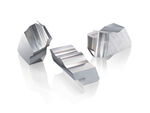
Haas Schleifmaschinen: Plates, weight - under a kilo of precision - in the micron range.
Towards infinity
I was equally amazed when I recently read that the Voyager 1 space probe has nearly reached the boundary of our solar system. Voyager 1 has been travelling for more than 33 years at a speed of around 60,000 kilometres per hour, heading towards infinity. The signals it transmits back to Earth now take approximately 16 hours to arrive. Is that not fascinating?
As an engineer and hobby pilot, I am deeply impressed by this technological achievement. Since we began using the Hubble Space Telescope in our Multigrind® CB campaign, we at Haas Schleifmaschinen have developed a special connection to space exploration.
And because one never knows who might be encountered out there in interstellar space, Voyager 1 carries a golden record on board. Not one by Elvis, but a record containing information of many kinds. A golden letter, so to speak, addressed to whom it may concern.
And since we are already talking about precision and boundaries, we at Haas Schleifmaschinen always welcome demanding grinding tasks. Tasks that help us push the limits of what is possible a little further each time.
Beam me up!
The author
Dirk Wember
Managing Director
Dirk Wember is an enthusiastic pilot, passionate engineer and managing director of Adelbert Haas.
Share article

Comments (0)
Write a comment