11.06.2026
When precision must not be distributed.
Planetary roller screw drives are among the most precise mechanical transmission elements of our time. They drive highly automated production systems, robotics, and future humanoid applications. High load. Minimal backlash. Absolute repeatability. And yet, their manufacturing is still mostly fragmented today.
Where complexity arises
The typical process chain: cylindrical grinding, profile grinding, gear grinding—on different machines. Each machine performs its task exceptionally well. But none can do everything. The result: multiple setups, positional and runout deviations, high setup and logistics effort, large footprint, and high unit costs. The Multigrind® Radical fundamentally challenges this principle.
The approach
The Multigrind® Radical does not focus on individual technologies. It focuses on the system. Not a process chain—but integration. Manufacturing takes place on a single platform: cylindrical grinding, profile grinding, gear grinding, worm profiles, roller screw-specific gearing, round and non-round grinding. All in a single setup. No limitations in gearing. No process compromises.
One setup: the precision lever
Every additional setup creates positional shifts, runout drift, iterations, and rework. The Multigrind® Radical eliminates this source. The result: maximum positional consistency, consistent functional relationships, no tolerance chain. Precision is not corrected—it is structurally secured.
Profile stability: actively maintained
Profile stability is achieved through continuous dressing. Depending on the application: every third, fifth, or tenth workpiece. The result: a consistently stable profile throughout the entire series.
Pitch compensation
Additionally, software-based pitch correction can be applied. This means the profile is not only generated—it can be actively stabilized through closed-loop control, i.e., active compensation based on measurement results.
Measurement and correction logic
The sequence: first a measuring cut, second grinding with allowance, third measurement, and fourth automatic compensation. The result: a perfect part—without manual iterations. In this context, “first part perfect” is not a slogan; it is lived process logic.
Runout: stable by design
The main runout influences for this component class: multiple reclamping operations, unfavorable proportions of large machines for small parts, and unstable positional references. The Multigrind® Radical addresses exactly these points: one setup, no machine changes, and the right machine size for the part. The proportions are correct—and that makes the difference.
Automation and platform: the structural lever
Classic specialized processes: not designed for small parts, no end-to-end automation concept, process switching instead of integration. The Multigrind® Radical relies on a fully integrated system: fast loading times, quick tool changes, and fully integrated automation. This production unit is suitable for series manufacturing—for small and medium batches as well as larger volumes. When the machining itself does not become faster, auxiliary times decide. And here, the advantage grows with every part.
At the same time, the Multigrind® Radical is not a special-purpose machine. It is a 5-axis universal machine. This means other components are possible tomorrow—no investment into a dead end, high flexibility. Automation and universality work together: stable processes today and security for future requirements.
Productivity
The productivity advantage does not come from more aggressive cutting. Instead, it comes from: grinding wheel changes in about 10% of the usual time, reduced setup times, optimized auxiliary times, and automation. Customer experience: 20–30% higher productivity with identical cutting time. Quality is assumed. Unit costs decide.
Conclusion
Many machines. Many interfaces. High complexity. Or: one platform. One setup. One continuous process. Precision is not corrected. Precision is structurally secured.
The author
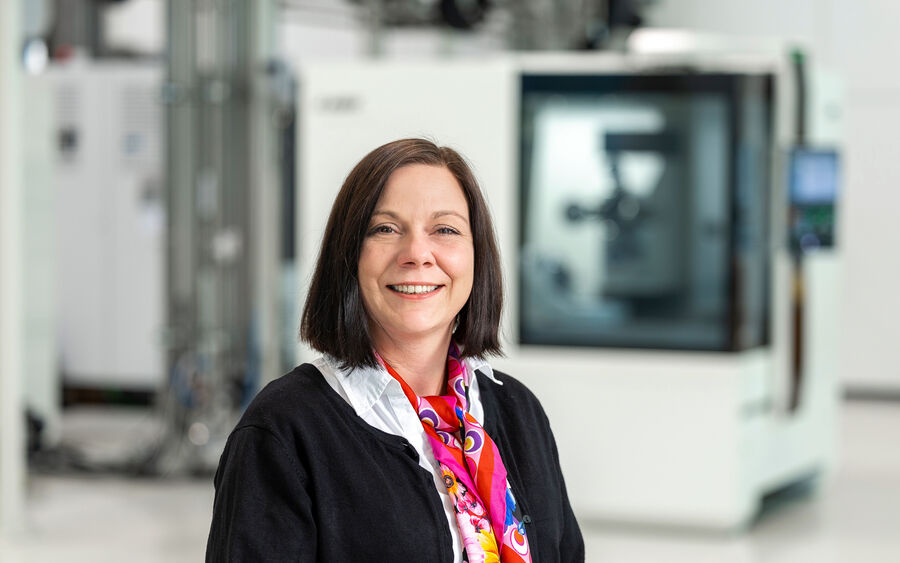
Carina Kabisreiter
Carina Kabisreiter is active in the marketing and communications department at Adelbert Haas.


Comments (0)
Write a comment