30.06.2026
FROM MACHINES TO SYSTEM
When automation is finally thought through to the end. Automation has long become standard. Robots load machines. Pallets are changed automatically. Processes run unmanned. Everyone shows it. Everyone can do it. And yet, one central problem remains unsolved: The process does not think. Machines work side by side. Systems are connected with each other, but not truly controlled. Decisions are made outside the system — by the operator.
The result: more automation, more complexity, more coordination effort. Many companies are noticing this: throughput times hardly decrease, while complexity increases. Why? Speed is not the problem. The problem is the lack of coherence. The real bottleneck is not the technology. It is the lack of process intelligence.
The Core: Multigrind® Multimation
Adelbert Haas’ approach is fundamentally different: We do not automate machines. We automate processes. Multigrind® Multimation is not an add-on. Not a module. It is the control system of production. This is not where it is defined how a single machine operates. This is where it is defined how the entire process works. Machines, robots, measuring systems, and ERP are brought together and controlled within a central logic. The key difference lies in the architecture: What should happen is defined centrally. How it happens is handled by the system. This is not integration. This is control.
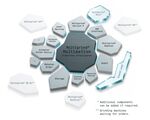
When systems begin to operate independently
Multigrind® Multimation not only executes processes, it coordinates them. Orders are prioritized. Workflows are controlled in a targeted manner. Production steps are aligned with each other. The result: fewer downtimes, more stable processes, more efficient use of resources. The process no longer runs rigidly. It runs in a structured and controlled way.
System Intelligence in Practice
Closed Loop: Quality is created within the process
Measurement data does not disappear into reports. It flows back into production. Deviations are not documented. They are actively compensated. This is the difference between control and regulation. And this is exactly where it is decided whether precision becomes reproducible.
Multigrind® Styx: Errors do not arise in the first place
With Multigrind® Styx, the process is fully run through in advance under realistic conditions. Collisions, workflows, geometries — everything is validated before the first real part is produced. The process does not start with trial and error. It starts with certainty.
Usability as the Key: Multigrind® Horizon V
The most important step inward
Adelbert Haas’ greatest strength has always been clear: maximum flexibility. At the same time, this was also the biggest point of criticism: too complex, too many possibilities, too difficult to operate. With Multigrind® Horizon V, this tension is resolved.
The full functionality remains intact. But operation now follows a clear logic: programming is oriented to the component, navigation is carried out directly in the 3D model, and the path to the finished program is drastically shortened — often to fewer than ten steps. The complexity does not disappear. But it no longer stands in the user’s way.
Software: The real lever
What many underestimate: software at Adelbert Haas is not a tool. It is the system that defines, validates, and controls the process. No more: writing programs. managing handovers. correcting errors. Instead: defining processes. validating processes. executing processes in a stable way. It is no longer the human who translates the process for the machine. The system translates requirements directly into production.
The Human in the System
From Operator to Process Pilot
With this development, not only the technology changes, but also the role of the human. The traditional machine operator controls individual processes. He reacts to deviations. He keeps production running. In the intelligent system, a new role emerges: the Process Pilot. He no longer intervenes in every step. He monitors the overall process. He understands relationships instead of just executing workflows. He no longer makes decisions at the machine level, but at the system level. And this is the key difference: Automation replaces manual work. System intelligence enables scalability.
Conclusion: What is really happening here
Multigrind® Multimation does not simply create connections. It creates coherence. No isolated solutions. No integration projects. No fragmented processes. But a system that thinks. From order to finished component: a continuous, controlled process. Multigrind® Multimation turns machines into a system. And automation into real control.
The author
Carina Kabisreiter
Carina Kabisreiter is active in the marketing and communications department at Adelbert Haas.

Comments (0)
Write a comment